Stella Nova
Gravitational imaging

Astrophysics · strong gravitational lensing · dark matter

A million-solar-mass object, found only by its gravity

Light that left a radio galaxy about 10 billion years ago bends around a closer galaxy and smears into a thin arc. One short stretch of that arc is dented. Nothing there shines, but the dent says that about a million Suns of mass sit in the foreground galaxy, within 80 parsecs of one point. That is a hundred times lighter than anything found this way before.

Powell, McKean, Vegetti, Spingola, White & Fassnacht, A million-solar-mass object detected at a cosmological distance using gravitational imaging, Nature Astronomy 9, 1714–1722 (2025).

1.13 × 10⁶M☉ inside 80 pc (m80)
26σdetection significance
3.3%uncertainty on m80
194 μasposition uncertainty
(1.5 pc)
z = 0.881lens galaxy
(source z = 2.059)
~5 masglobal VLBI resolution
at 1.7 GHz
01

The lens: JVAS B1938+666

An elliptical galaxy at z = 0.881 sits almost exactly in front of a radio galaxy at z = 2.059. Its gravity maps each point of the background sky to one, two or four points on our sky.

What the radio telescope sees

toy lens made to look like Fig. 1
image plane200 mas

The bright source lies just inside a fold of the caustic, so two of its four images merge into the long, thin arc on the upper right. Drag the green V along or off the arc: section 2 follows it. A is the 108 M☉ perturber reported in 2012 from Keck adaptive-optics images. The square marks the 60 mas zoom of Fig. 1.

Where the light starts

toy source
source plane20 mas

Drag the bright lobe. The blue line is the caustic: inside it a point has four images, outside it two. Slide the lobe across the fold and watch the merged arc split or vanish. The faint lobe to the north stays outside and gives two images.

The lens equation

paper eqs. 6 and 7

A ray seen at θ left the source plane at β. The deflection α comes from the projected mass, in units of the critical density.

For zl = 0.881, zs = 2.059 and Planck 2015. This page recomputes it as 1.501 × 10¹¹; 1 mas is 7.96 pc at the lens.

The smooth galaxy: an elliptical power law with slope γ (2 is isothermal), plus external shear. The paper also adds m = 3, 4 multipoles.

The lensing scale of a million Suns at this distance is smaller than the 5 mas beam. Section 2 shows why it is still found.

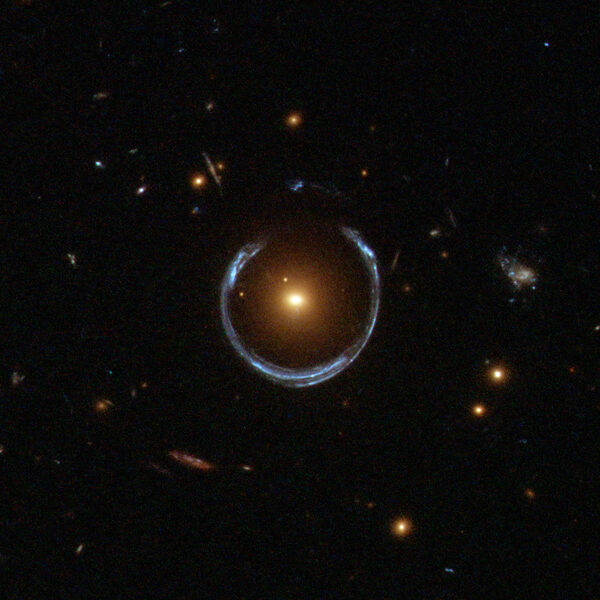
A real Einstein ring, seen by Hubble

photograph, a different lens
Hubble photograph of the Cosmic Horseshoe: a red elliptical galaxy inside an almost complete blue ring

This is not B1938+666. It is LRG 3-757, the “Cosmic Horseshoe”, in visible light. A red elliptical galaxy in front bends the light of a blue galaxy far behind it into an almost full ring, about 10″ across. B1938+666 makes the same shape at radio wavelengths, about 1″ across. The arcs in the figures above are a toy of that ring.
Photo: ESA/Hubble & NASA, CC BY 4.0, cropped and resized.

02

A gap in the arc

Near a critical curve the lens magnifies tangentially by a huge factor. A pull of a fraction of a milli-arcsecond then moves the arc by much more, and a thin arc shows the dent.

60 mas around V, through a 5 mas beam

image plane, not visibilities
data: lens with V
best smooth model
residual (σ)
m80 of V

The smooth model is the lens without V, but it may absorb any part of V's pull that is uniform or changes linearly across the window: a source shift plus a local change of convergence and shear. What is left is V's own signature at the crossing of the arc and the critical curve. Turn off the beam to see the raw dent. The noise is 1/350 of the arc's peak, as in the VLBI map (34 μJy per beam against about 12 mJy per beam).

The caustic folds over the source

source plane, 8 mas
caustic near the bright lobe

Dashed: the caustic of the smooth lens. Solid: with V. Where the fold passes over the bright radio lobe, V moves it and puts a kink in it. The paper's Fig. 2 shows the result: without V, the fitted source has to break along the caustic to imitate the dent.

03

Resolution sets the lightest mass you can see

The mass of a perturber sets the size of its lensing signature. A beam much wider than that signature averages the dent away.

The same V through different telescopes

same noise for every beam
data
residual (σ)
beam FWHM

Detection floor

read the slope, not the height

Line: the m80 that leaves a 5σ residual peak in this toy, for each beam (computed with the same engine by build-floor.mjs). Dots: perturbers found so far in galaxy-scale lenses with resolved arcs. The toy knows the source exactly and gives every telescope the same signal-to-noise, so its floor sits lower than in real data. The trend is the point: a narrower beam reaches lighter objects.

An Earth-sized telescope

19 antennas, VLBA + EVN, 14 h
longest baseline

04

Gravitational imaging: a map of missing mass

Gravitational imaging does not assume a shape or a place for a perturber. It adds a free correction δψ to the lensing potential on a grid of pixels, and lets the data say where mass is missing.

Recovered convergence correction, 80 mas around V

solver knows the true source
κGI (red: extra mass)80 mas
residual before GI (σ)
λψ

Enclosed mass, every run

like Fig. 3

Each run adds a curve: the mass of κGI inside radius r of its peak. Grey: the true PJ profile of V. In the paper, six runs (three penalties, two grids) gave 0.83–1.8 × 10⁶ M☉ at 80 pc, so the result was then checked by a parametric fit. Turn off "V in the data" to see what noise alone makes.

How the solver works

paper eqs. 13–18, simplified

Linearise the image in the potential correction. The paper solves for the source S and δψ together; this toy keeps S fixed at the truth.

One Newton step, solved by conjugate gradients, four steps per run. A is blur(−∇S·∇), R penalises κ, its gradient or its curvature.

The correction to the convergence. The paper writes −½∇²ψ in its sign convention. Features above 3σGI count as real.

The extra deflection. A Gaussian prior on δψ makes noise look like a smooth random field, which is why the paper uses a 3σ threshold.

05

Weighing it: why 80 parsecs

A truncated isothermal (pseudo-Jaffe) profile has two numbers, total mass and truncation radius. The data cannot separate them, but they pin the mass inside one radius very well.

Cylindrical mass M(<r) of a PJ profile

paper eq. 9, integrated
rt
mtot

With m80 held, every (mtot, rt) pair passes through the same point at 80 pc. Grey curves span rt = 149 ± 18 pc. The paper found 80 pc to be the radius where the enclosed mass and rt are uncorrelated, so it quotes m80 = (1.13 ± 0.04) × 106 M☉. Release the hold to change mtot on its own.

The profiles

paper eqs. 9 and 10

Integral of the line above. At 80 pc: mtot 2.82 × 10⁶, rt 149 pc gives 1.13 × 10⁶.

PJ_tidal fixes rt to the tidal radius. For V that gives 53 pc, too compact: the evidence drops by 16. V may sit farther from the galaxy centre along the line of sight than its projected distance.

Table 1: every model the paper compared

tap a row

Δlog ℰ is the Bayesian log-evidence relative to the smooth galaxy alone. The significances in the paper follow σ ≈ √(2 Δlog ℰ) between two models: adding V to the best model without it gives Δlog ℰ = 364 − 16 = 348, or 26σ. A alone is a 5.7σ effect in these data.

06

What is it?

The lens tells us mass, size and position. It does not say whether the mass is dark.

How many such clumps should there be?

paper eqs. 19 and 20
WDM particle

Warm dark matter erases small haloes below a half-mode mass Mhm. The expected number μ of subhaloes of 106–107 M☉ in the sensitive area of 1.06 × 10⁻² arcsec2 sets P(n ≥ 1) = 1 − e−μ. The paper reports 0.65 for cold dark matter, 0.36 for 9.1 keV and 0.14 for 4.6 keV. This page scales from the cold-dark-matter value with the half-mode mass of Schneider et al. (2012) and gets 0.38 and 0.16: close, not identical. One detection does not separate the models; its density profile might.

Candidates

companion paper, as reported
  • Dark-matter subhaloIts presence is in no strong tension with the expected numbers in cold or warm dark matter. But the best NFW fit is much more concentrated than simulated cold-dark-matter subhaloes, as for A and for the 109 M☉ object in SDSS J0946+1006.
  • Intermediate-mass black holeIts profile is disfavoured at high significance.
  • Globular clusterDisfavoured at high significance.
  • Ultracompact dwarf galaxyA relatively extended one is not ruled out. Deep optical or infrared images could find its light, but the lensed optical arc lies on top of it.
07

What is real here, and what is a toy

The figures run a small lens model in your browser. They show the mechanisms of the paper, not its data.

From the paper. Every mass, radius, position uncertainty, evidence and probability in the text and in Table 1. The redshifts, the 5 mas resolution, the noise level, the PJ and power-law formulas, the WDM mass function and its constants.

Recomputed. Σcr = 1.501 × 10¹¹ M☉ arcsec−2 and 7.96 pc per mas, from Planck 2015 distances. M(<r) of the PJ profile, which gives the paper's m80 from its mtot and rt for both PJ_free and PJ_tidal.

Toy. The lens and source parameters, made to look like Fig. 1 (the paper does not list them). Residuals are made in the image plane; the paper fits the 1.7 GHz visibilities directly with PRONTO and uses nested sampling for the evidence. The smooth model may only absorb a linear part of V's pull. The GI solver keeps the source fixed at the truth. So the toy's residuals are larger than the paper's (tens of σ here, more than 5σ there) and its detection floor is too low.

Data. The VLBI observation (project GM068) is public in the EVN archive. This page does not use it.

Powell D. M. et al. 2025, Nature Astronomy 9, 1714. doi:10.1038/s41550-025-02651-2
Tessore N. & Metcalf R. B. 2015, A&A 580, A79 — deflection of the elliptical power law used here.
Schneider A. et al. 2012, MNRAS 424, 684 — half-mode mass of warm dark matter used in section 6.
Vegetti S. et al. 2012, Nature 481, 341 — the earlier detection of A in JVAS B1938+666.